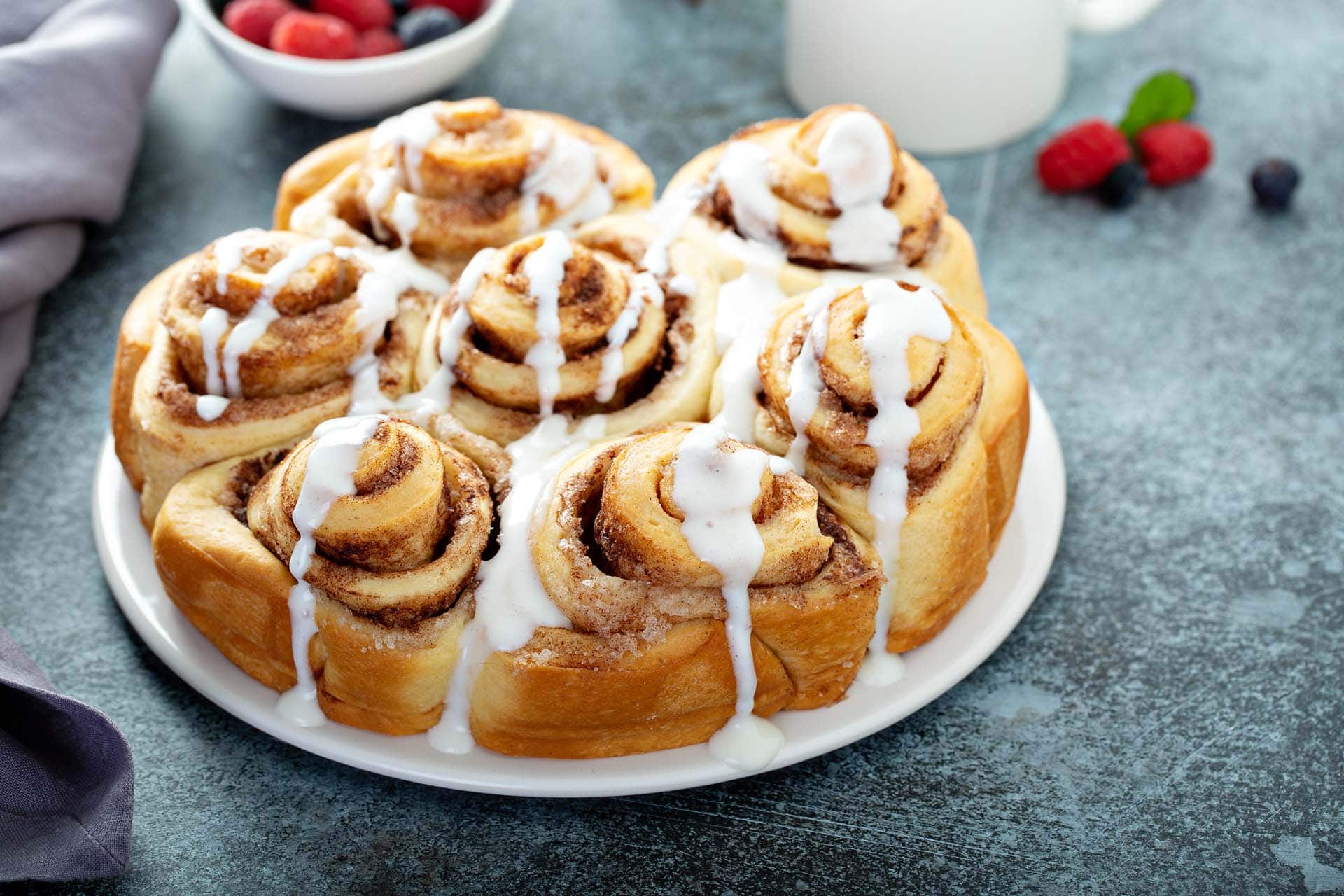
Decadent Cinnamon Rolls with Cream Cheese Icing
These indulgent cinnamon rolls have a cult following. Cinnabon who? These are definitely on the sweet side, but you could take them more to the savory side swapping in breakfast sausage.
Equipment
- Stand mixer You may be able to get away without it, but it will make your life so much easier.
- Pastry brush Not essential but makes spreading your melted butter cleaner and easier.
- Disposable aluminum baking pans You could use regular 9" x 13" baking pans, but these make clean-up a breeze!
Ingredients
Dough
- 2 pkg active dry yeast (not instant)
- 1 C. warm water If you have a digital theromometer, aim for 105º to 115ºF)
- 2/3 C. granulated sugar plus 1-2 tsp additionally to add to your active yeast
- 1 C. warmed milk
- 2/3 C. butter salted or unsalted; I usually have salted in the house
- 2 eggs allowed to come to room temp, slightly beaten
- 7-8 C. all-purpose flour plus a little extra if needed You can weigh this out as well; one cup is about 120 g.
Filling
- 2 C. melted butter I always have extra on-hand, just in case I feel it needs more
- 2 C. brown sugar Again, I have a little extra available
- 3 tbsp ground cinnamon
- 1 tbsp ground ginger
- 1 tsp ground nutmeg
- 1/2 C. heavy cream, slightly warmed I have used milk in a pinch, but heavy cream is better
Icing
- 1 lb. butter, softened
- 1 lb. cream cheese, softened
- 2 lbs. powdered sugar, sifted
- 2 tsp. lemon juice fresh squeezed is best
- 2 tsp. pure vanilla extract If all you have is imitation vanilla you can use it, but pure really does taste so much better
Instructions
Prepare the dough
- In a small bowl, mix together the warm water, active yeast and 1 to 2 tsp granulated sugar. Set aside.
- In your mixer bowl (or a large bowl if you’re not using a mixer), mix together your warmed milk, remaining 2/3 c. sugar, melted butter, salt, and eggs until well combined using your mixing paddle. Your active yeast mixture should have activated; you should see almost like a foam formed in your bowl. Add your activated yeast mixture to your large mixing bowl, mix until just combined. Next add half of your flour and beat until smooth. You shouldn't see any lumps. Keep slowly adding flour until your dough becomes slightly stiff and although still sticky will start to pull away from your bowl.
- Prepare a bowl for you dough to rise in. Liberally butter the sides and bottom of a large glass or plastic bowl.
- Turn out your dough onto a well-floured board or counter top. I prefer flouring the counter top so I’m not fighting a board moving, but you do you. Hand knead your dough for 5 to 10 minutes. Place into your prepared buttered bowl; cover with a flour sack towel, large cheesecloth, parchment or wax paper. You want to let this rest in a warm place, free from drafts, until doubled in size, about 60 to 90 minutes.
- Once your dough has doubled, punch down the dough (literally punch it and watch it deflate some). Let it rest for 5 more minutes, then roll out on a well floured surface (I again use my counter). Aim to roll out a rectangle approximately 15" x 20". The first few times I had a tape measure to get an idea of what that should look like, now I eyeball it and close is good enough for me.
We don’t really have a warm, draft free place that’s not in the way, so before I knead the dough I turn on our oven to the lowest temp I can to let it start to heat (in our case, 175ºF). I pop a 4 C. glass Pyrex measuring cup of water into the microwave for 4 minutes, and then pour that water into an oven safe pot. After the 4 minutes I turn the oven off. I place the pot of water as low as I can in the oven, adjusting the shelf above to ensure my glass bowl of dough will fit above it. This provides a warm, draft-free, out of the way place for my dough to rise.
Prepare the filling and your baking pans
- Use the pastry brush to help you spread 1/2 c. melted butter evenly across your dough, all the way to the edges. Mix together 1-1/2 to 1-3/4 c. brown sugar with the cinnamon, ginger, and nutmeg. Evenly distribute the mixture over the melted butter on your dough.
- I like to cut the dough into strips prior to rolling, it just works easier for me. I make the first cut to divide the dough into halves (so giving you roughly 15" x 10" halves). Then cut strips roughly 1" to 1-1/2" in width. At this size, I use two of the disposable aluminum baking pans.
- Before moving forward, prepare your baking pans. Divide and pour the remaining melted butter into the bottom of your baking pans. You should have roughly 1/2 c. to 3/4 c. in each pan, depending on how exact you were with the amount of butter you brushed on your dough. Take the remaining brown sugar and sprinkle it into the melted butter in the bottom of your baking pans. This is going to make a lovely almost caramel for the rolls to bake into.
- Now that your pans are prepared, roll each of your dough strips jelly roll style, keeping them as tightly rolled as possible. Place your rolls snugly together, with the spiral side up. Let the rolls rise again, in a warm place, until your rolls have doubled in size (about 45 to 60 minutes).
I like to use the aluminum disposable pans to make clean-up a breeze!
For larger rolls cut wider strips; for smaller rolls cut smaller strips.
I again turn our oven on the lowest setting to just get a little warmth back into the oven; the pot of water is still in the bottom. No need to warm it back up, it can still create a warm, moist rising environment.
Although the recipe calls for set amounts of butter and brown sugar I always have extra available. Sometimes I want more butter and brown sugar to caramelize in the bottom of the pans. No one has ever complained about more butter and more brown sugar.
Bake the rolls
- Now that your rolls have doubled, preheat your oven to 350ºF. While the oven is preheating, warm your heavy cream just slightly. Pour approximately 1/4 c. of the warmed heavy cream over the top of each pan of rolls (depending on how many pans you ended up with based on the size of your rolls). Let that warm cream slowly penetrate the rolls while the oven preheats.
- Bake for about 25 to 30 minutes. Your rolls should turn a nice light brown, but if poked with a tester it shouldn’t pull out any raw dough. Set the baked rolls aside.
Prepare your icing
- After you’ve let your butter and cream cheese come to room temperature, beat them together in a large bowl or your large mixer bowl.
- Beat your cream cheese and butter together until well combined. Slowly add your sifted powdered sugar.
- Once all of the powdered sugar has been added, let your mixer mix the contents for an additional 10 to 12 minutes. Just before you’re done mixing, add the lemon juice and pure vanilla extract. All that mixing leaves you with a fluffy cream cheese icing that will have people coming back for more.
You could attempt to prepare this icing by hand, but it won’t get near the airiness. At a minimum, have a hand mixer on hand.
Sifting your powdered sugar helps eliminate any lumps or chunks.
Serve your rolls
- You can ice your rolls in the pan, but I prefer to ice each roll individually; it makes it easier to pull them out of the pan and allows people to decide if they want to be modest with the icing or to smother that baby.
Notes
The width you cut your dough to will determine how many rolls you end up with. I used to keep my cuts wide, resulting in finished rolls that were bigger than my fist. They were showstoppers, but with the filling and the icing being so rich most people said they couldn’t finish them. I decided to slim down my cuts, resulting in more overall rolls that were a more manageable portion for people.
Store any unused icing in the fridge; you will have leftover icing. It also goes well with graham crackers!